©
Barred Warbler © Marcel Burkhardt
Swiss Breeding Bird Atlas 2013-2016

Messengers from the east

In the past 100 years, Switzerland has seen several new additions to its birdlife, especially from the east. Most new arrivals remain scarce visitors with heavily fluctuating numbers, but there are two notable exceptions: Fieldfare and Eurasian Collared-dove.

Within the western Palaearctic, the central European countries form a kind of threshold. The climate gradually changes from maritime in western Europe to continental in eastern Europe. In terms of biogeographical regions, species of western or African origin mingle with birds from the east. Switzerland lies at the western edge of this transition zone, just within reach of the wave-like advances of eastern species. Ten such species have arrived in Switzerland in the past 100 years. Two of them, Fieldfare and Eurasian Collared-dove, have become widespread, while others – White-backed Woodpecker, Citrine Wagtail, River Warbler, Barred Warbler, Greenish Warbler, Red-breasted Flycatcher, Eurasian Penduline-tit and Common Rosefinch – are still rare and subject to wide fluctuations.

Breeding by Fieldfare and Eurasian Collared-dove was confirmed in 1923 and 1950, respectively, followed by Barred Warbler and Eurasian Penduline-tit in 1952. The Penduline-tit bred another 32 times until 2014, although only two records date from the 21st century. The Barred Warbler population reached its peak in the 1960s and 1970s (15–20 pairs) as well as in the early 1990s. In 2013–2016, only few territories were still occupied.

In the case of the Common Rosefinch, singing birds were first recorded in 1979; the first breeding attempt followed in 1983. After a wave of colonisation in the 1990s, a second advance has been underway since 2010, but has so far not gone beyond the Alps.

The White-backed Woodpecker has been recorded in Liechtenstein since 1981 and in Switzerland since 1996, and breeding has occurred in both countries since at least 1996 and 1999, respectively. It appears to have become firmly established in the Prättigau GR and the Rhine Valley SG/GR, gradually advancing westwards.

The approach of Citrine Wagtail, Red-breasted Flycatcher and River Warbler is more hesitant: for the first two species, breeding has been confirmed twice, in 1997 and 2012 (Citrine Wagtail), and in 2003 and 2006 (Red-breasted Flycatcher); the River Warbler bred just beyond the Swiss border in 2011. Finally, colonisation by the most recent arrival, the Greenish Warbler, appears to have more momentum: four territories were occupied between 2014 and 2017, resulting in at least one brood and raising hopes for a positive future trend.

The advances and retreats described here are unpredictable. While the causes are not clear, they are presumably related to the dynamics, often random, of peripheral populations.

Species concerned

Recommended citation of the Atlas online:
Knaus, P., S. Antoniazza, S. Wechsler, J. Guélat, M. Kéry, N. Strebel & T. Sattler (2018): Swiss Breeding Bird Atlas 2013–2016. Distribution and population trends of birds in Switzerland and Liechtenstein. Swiss Ornithological Institute, Sempach.

References

Shop

Donate
Help the birds of Switzerland.
Your support allows us to monitor stocks, identify problems, develop solutions and provide assistance to endangered species.
Donate Now
Logo Zewo

We handle the donations entrusted to us very carefully. For many years, the Swiss Ornithological Institute has carried the ZEWO seal of approval for non-profit institutions.

Swiss Breeding Bird Atlas 2013-2016

Birds face a changing world

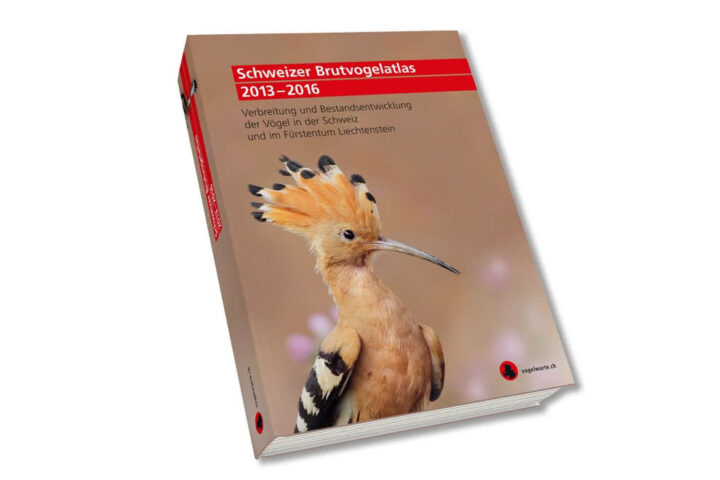
The state of birdlife reflects our relationship with nature and our landscapes. The atlas presents the current distribution, abundance and altitudinal distribution of all breeding birds in Switzerland and Liechtenstein with unprecedented precision. Most importantly, it highlights the profound changes that have taken place in the Swiss avifauna over the past 20 to 60 years. This comprehensive reference book provides an important foundation for the protection and conservation of native birds and their habitats.

Learn more