©

This juvenile Bearded Vulture is from a nest in the Upper Engadine GR.

© David Jenny
Swiss Breeding Bird Atlas 2013-2016

The return of the Bearded Vulture

Once extirpated in the entire Alpine range, the Bearded Vulture now inhabits large parts of the Alps in the Valais and Grisons again. The successful reintroduction of Switzerland’s largest bird of prey is a fine example of cross-border collaboration in raptor conservation.

The situation of vultures worldwide is alarming. The return of the Bearded Vulture to the Alps, however, is a success story, making it a positive exception among vultures.

As late as 1850, the Bearded Vulture was widespread in large parts of the Alps. Due to direct persecution encouraged by bounties, the population rapidly declined and became extinct towards the end of the 19th century. Breeding was last recorded in Switzerland in 1886 near Vrin GR. Today, the Bearded Vulture has returned to the Alps thanks to an international reintroduction scheme.

The reintroduction of extinct species is a last resort in nature conservation and governed by strict guidelines. The following conditions were met in the case of the Bearded Vulture in the Alps: the causes for extinction are known (direct persecution) and have been resolved, habitat quality is adequate (food supply, nesting sites) and natural recolonisation is unlikely.

In 1986, the first Bearded Vultures from a European breeding programme were released in Hohe Tauern A, followed by annual releases in Haute-Savoie F, the Maritime Alps F/I and the Swiss National Park GR (1991–2007). In Switzerland, reintroductions are coordinated by the foundation Pro Bartgeier. By 2017, a total of 45 fledglings from the breeding programme had been released at three different sites.

The first wild-born broods were recorded in Haute-Savoie in 1997, in Bormio I in the central Alps in 1998 and in Switzerland in 2007, when three pairs bred successfully. Since then, there have been 1–2 new pairs every year. Intensive monitoring of breeding pairs by the foundation Pro Bartgeier provides the basis for further conservation measures. In 2017, the Swiss birds made up about 40 % of the Alpine population. Despite the positive trend, the small population remains fragile. Illegal shooting has become rare, but still occurs occasionally (in Crans-Montana VS in 1997, in Samnaun GR in 2008).

New breeding pairs usually nest close to their place of origin (release or nest site). Due to their distance from the core ranges, other Alpine regions such as central Switzerland and Ticino have not yet been populated. Release sites in the eastern (Calfeisental SG, 2010–2014) and central Swiss Alps (Melchsee-Frutt OW, from 2015) will hopefully lead to new populations in these areas. The reintroduction scheme aims for the Bearded Vulture to colonise the entire Alpine range, and for the Alpine population to connect with the vigorous population in the Pyrenees, but also with the unstable populations in Corsica and Crete.

Species concerned

Bird species
Bearded Vulture
The Bearded Vulture is the largest bird in the Alps with a wing span of over 2.6 metres. In the past, many myths prevailed about this vulture, which is still evident in the non-scientific names such as “Rossgyr” (horse vulture), “Gemsengeier” (chamois vulture) or “Lämmergeier” (lambs vulture). By...
Learn more

Recommended citation of the Atlas online:
Knaus, P., S. Antoniazza, S. Wechsler, J. Guélat, M. Kéry, N. Strebel & T. Sattler (2018): Swiss Breeding Bird Atlas 2013–2016. Distribution and population trends of birds in Switzerland and Liechtenstein. Swiss Ornithological Institute, Sempach.

References

Shop

Donate
Help the birds of Switzerland.
Your support allows us to monitor stocks, identify problems, develop solutions and provide assistance to endangered species.
Donate Now
Logo Zewo

We handle the donations entrusted to us very carefully. For many years, the Swiss Ornithological Institute has carried the ZEWO seal of approval for non-profit institutions.

Swiss Breeding Bird Atlas 2013-2016

Birds face a changing world

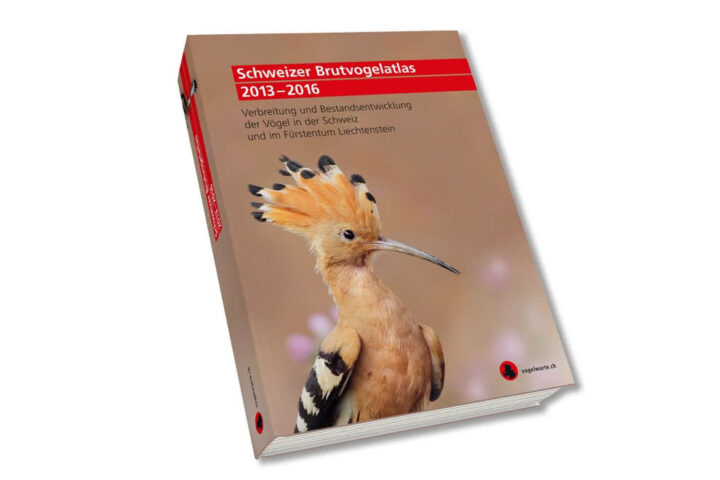
The state of birdlife reflects our relationship with nature and our landscapes. The atlas presents the current distribution, abundance and altitudinal distribution of all breeding birds in Switzerland and Liechtenstein with unprecedented precision. Most importantly, it highlights the profound changes that have taken place in the Swiss avifauna over the past 20 to 60 years. This comprehensive reference book provides an important foundation for the protection and conservation of native birds and their habitats.

Learn more