


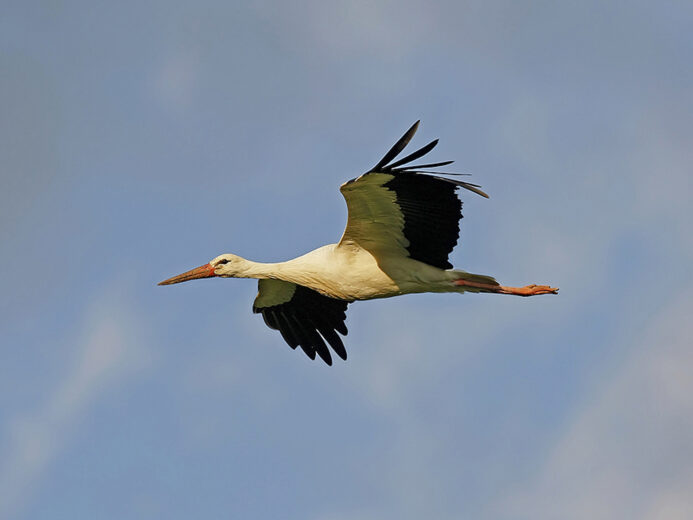
The White Stork lives in open farmland and builds its nests, which it uses year after year, on exposed trees, buildings or other man-made structures. It forages in arable fields and extensively used meadows and pastures, as well as wetlands, where it preys on small mammals, amphibians and earthworms.
In 1950, following a sharp decline, the species disappeared as a breeding bird in Switzerland. Thanks to reintroduction projects, the number of breeding pairs rose again to 269 by 2010. The development of the population is well documented thanks to the monitoring of broods and ringing of nestlings, and in 2024 there were more than 1,000 pairs.
The White Stork's recovery can be supported through specific conservation measures such as constructing nesting platforms or creating wet meadows.

©
© Marcel Burkhardt
Conservation programme for birds in Switzerland - Priority species
White Stork
Distribution and development
Schematic distribution
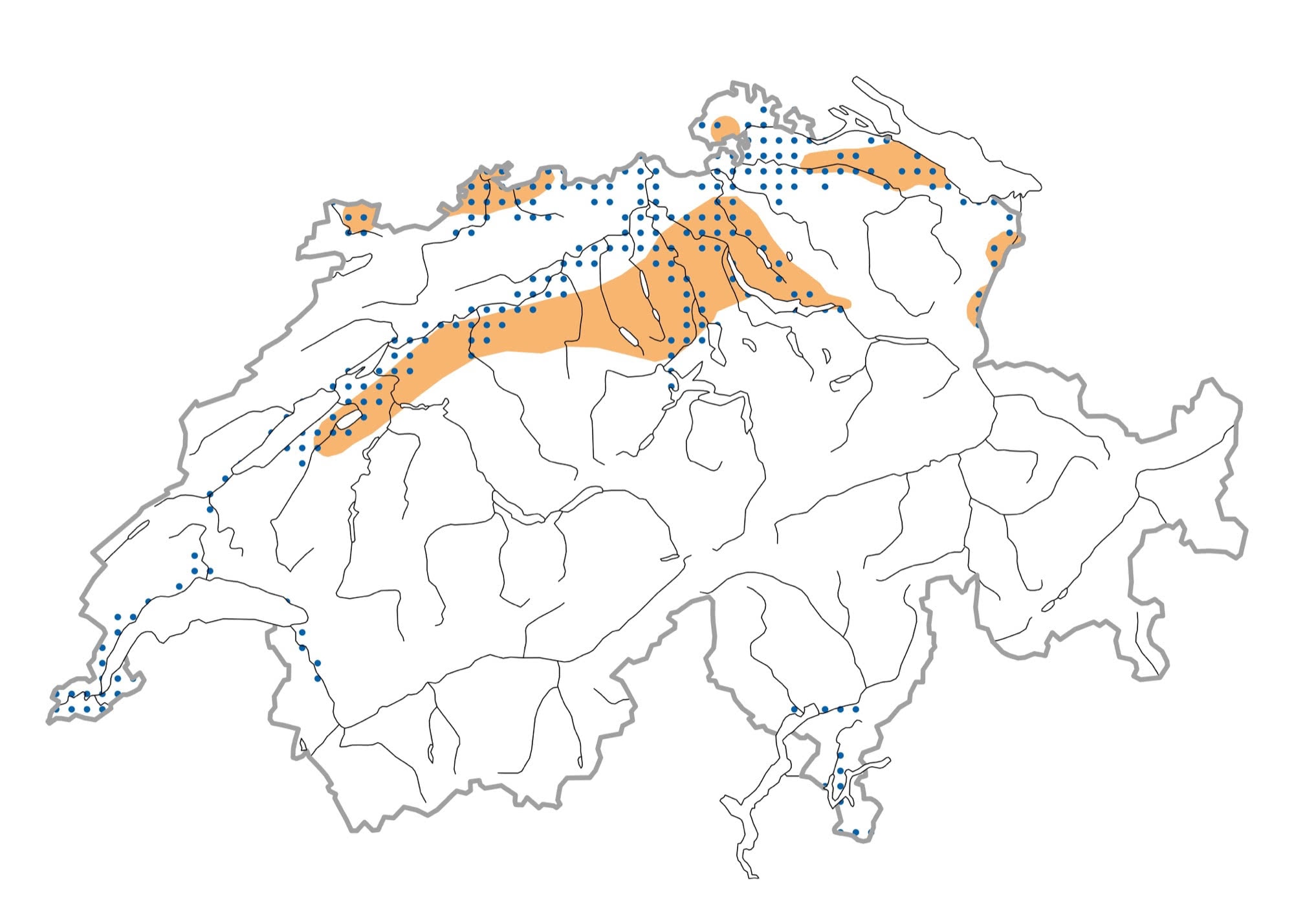
Schematic distribution during the breeding season (ochre), in winter time (dotted in blue) or during migration periods (dotted in vinaceous).
Breeding bird index
The graph shows the relative evolution of the breeding population in Switzerland (100 = mean value). Example: A value of 130 means that the population in the corresponding year was 30% above the mean value of the entire period considered.
Habitat and food

©
© Margrith Enggist
Nesting platforms on former telegraph poles in Unterlunkhofen AG.

©
© Margrith Enggist
Foraging on a wet meadow in Kleindietwil BE.

©
© Margrith Enggist
Foraging on a freshly ploughed field.


Conservation programme for birds in Switzerland - Priority species
White Stork
The White Stork lives in open farmland and builds its nests, which it uses year after year, on exposed trees, buildings or other man-made structures. It forages in arable fields and extensively used meadows and pastures, as well as wetlands, where it preys on small mammals, amphibians and earthworms.
In 1950, following a sharp decline, the species disappeared as a breeding bird in Switzerland. Thanks to reintroduction projects, the number of breeding pairs rose again to 269 by 2010. The development of the population is well documented thanks to the monitoring of broods and ringing of nestlings, and in 2024 there were more than 1,000 pairs.
The White Stork's recovery can be supported through specific conservation measures such as constructing nesting platforms or creating wet meadows.
Birds of Switzerland

White Stork
To the species profile in the bird database
Project managers


Threats, activities and forecasts
Limiting factors and threats
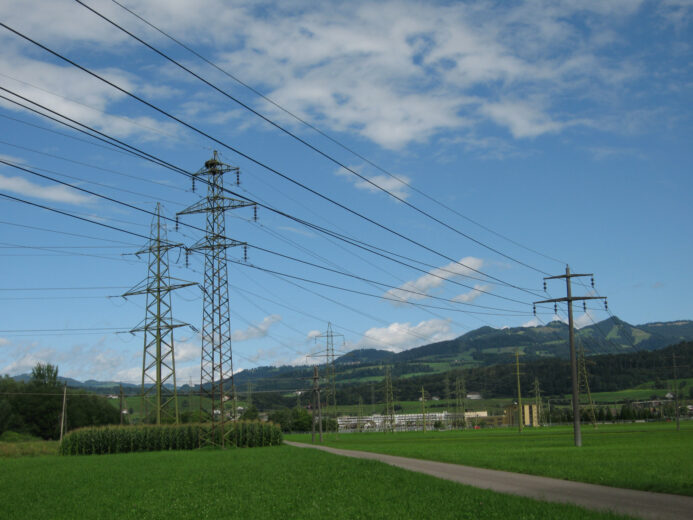
Collisions with overhead lines and electrocution pose the greatest risk for the White Stork. At the local level, there is a shortage of good foraging habitats close to nesting sites.
Breeding season
- In traditional colonies, competition for suitable nesting sites is sometimes very fierce.
- Cool wet weather during the nestling period reduces breeding success.
- Waste brought into the nest or fed poses a risk to both nestlings and adult birds.
Migration/ Winter
- Collisions with overhead lines and electrocution during migration.
- Lack of good foraging habitats on some migration routes and in some wintering grounds.
- In southern Europe and Africa, hunting is still a problem.
Necessary activities
Monitoring
- If possible, continue monitoring of nests throughout Switzerland with checks on occupancy and breeding success.
- Decades of ringing of nestlings and ring readings from breeding birds and on migration routes have provided important information on population trends, mortality and migration behaviour.
Conservation
- Advice and awareness-raising activities are needed to prevent conflicts.
- Provide support for large colonies (e.g. maintenance of nests).
- Create or maintain foraging habitats close to nesting sites.
- Mitigate risks: repair hazardous medium-voltage power poles.
Research
- Determine the importance to population development of breeding success, survival rates and inward/outward migration.
- Understand migratory and overwintering behaviour in the context of climate change.
Prospects for success and prognostics
- The species benefits from mild winters in Europe, but increasingly extreme weather conditions in spring (wet/cold or very dry) will have an adverse impact on breeding success.
- Impact of the closure of open landfills in southern Europe unclear.
- Can increasingly serve as an umbrella species for the conservation of wetland areas in agricultural habitats.
- Strong population growth leads to decreasing tolerance locally – increase awareness-raising.
Conservation measures and stakeholders

Offer and maintain nesting aids
The provision and maintenance of nesting platforms and the provision of suitable branch material for nest building help counteract the lack of natural nesting opportunities.
Municipalities
Nature conservation
Private individuals

Creating wet meadows and wet arable land
Wet meadows and wet arable land are valuable habitats and help provide food.
Show more
Agriculture
Communities
Municipalities
Nature conservation

Promote extensive farming
Unfertilised meadows and avoiding pesticides or mulching promote the diversity of plants and insects and thus the quality of the habitat (nesting sites, food supply).
Show more
Agriculture

Take nesting sites into consideration in construction projects
Known nesting sites of building breeders (e.g. via inventories in municipalities) should be taken into account in construction projects.
Show more
Industry and commerce
Municipalities
Planners and architects
Private individuals

Remediate dangerous cables / masts
Collisions can be prevented with appropriate markings on cables, and electric shocks (electrocution) through insulators or covers on electricity pylons.
Show more
Cantons
Industry and commerce
Municipalities



©
© Marcel Burkhardt
Birds of Switzerland
White Stork
The White Stork is well known for the legend that it brings babies and also as the lucky Stork Adebar. Since ancient times, the stork has been deified and protected by a number of peoples as a harbinger of fecundity. Intensification and mechanisation of agriculture are responsible for the problems the birds have in providing their young with sufficient food. Further difficulties aris...
To the species profile in the bird database


