©

Platform near Salavaux VD on Lake Murten with nesting Black-headed Gulls (and one Common Tern).

© Pascal Rapin
Swiss Breeding Bird Atlas 2013-2016

Nesting sites for gulls and terns

Gulls and terns breed in the transition zone between land and water. Breeding in colonies on islands allows them to defend collectively against predators from the air or protect the site against competitors. Today, most gulls and terns depend on artificial nesting sites.

In the past centuries, river engineering works have massively altered the shores of rivers and lakes in Switzerland. The Common Tern bred on gravel bars in over 30 sites in the early 20th century, but these breeding sites were subsequently lost. The population reached its low point in 1952, when only a single colony remained in the Fanel BE/NE. With the construction of artificial gravel islands (from 1929 in the Fanel) and the provision of nesting rafts and platforms (from the 1970s in all parts of the Central Plateau), a growing number of alternative breeding sites were made available. The population subsequently increased from 47 pairs in 1948 to 218 pairs in 1976. As further nesting sites were provided from 1990 onwards, numbers grew to the current level of 600–700 pairs. In 2015, nesting by Common Terns was encouraged on a flat roof by Lake Zurich and resulted in breeding success.

The first Swiss colony of Black-headed Gulls was discovered in 1865 in the Kaltbrunner Riet SG, where the gulls nested on tufts of sedges. Other natural wetlands in northeastern Switzerland and in the Fanel were colonised between 1925 and 1974. After 1965, the colonies gradually moved to the newly created gravel islands. The population increased significantly, reaching a maximum of 3800 pairs in 1980. In a pattern similar to neighbouring areas across the border, it then decreased again, stabilising at about 500–1000 pairs from the year 2000.

The Yellow-legged Gull colonised Switzerland from 1968, and numbers remained low for a long time before increasing steadily after 1997 to currently about 1400 pairs. The species has spread across the entire Central Plateau. In 1994, the first two Swiss records of roof nesting by Yellow-legged Gulls were confirmed near Lake Geneva. Roof nesting was recorded in other places as well from 2002 onwards. While most records relate to a single pair per building, a colony on a flat roof near Allaman VD grew to 45 pairs by 2017 (J. Duplain), and nests were found on 35 different buildings in Neuchâtel in 2016 (M. Zimmerli).

Today, all gulls and terns nest on artificial structures, either roofs or specially provided nest sites. Several measures exist to reduce nest-site competition between different species. For example, the Yellow-legged Gull, a dominant species and early breeder, can be prevented from occupying a site by waiting for the arrival of Black-headed Gulls and Common Terns before launching rafts and gradually removing winter covers from platforms.

The species are adapted to changing habitats and are flexible in their choice of nesting sites. So that all species can breed side by side and spill over to alternative sites if predation pressure is great, a large enough network of nesting sites is required, similar to the natural sites that used to exist on rivers.

Species concerned

Recommended citation of the Atlas online:
Knaus, P., S. Antoniazza, S. Wechsler, J. Guélat, M. Kéry, N. Strebel & T. Sattler (2018): Swiss Breeding Bird Atlas 2013–2016. Distribution and population trends of birds in Switzerland and Liechtenstein. Swiss Ornithological Institute, Sempach.

References

Shop

Donate
Help the birds of Switzerland.
Your support allows us to monitor stocks, identify problems, develop solutions and provide assistance to endangered species.
Donate Now
Logo Zewo

We handle the donations entrusted to us very carefully. For many years, the Swiss Ornithological Institute has carried the ZEWO seal of approval for non-profit institutions.

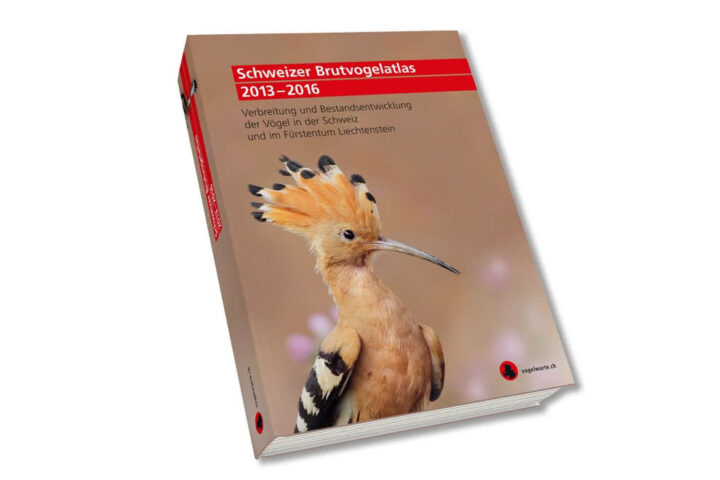
Swiss Breeding Bird Atlas 2013-2016

Birds face a changing world

The state of birdlife reflects our relationship with nature and our landscapes. The atlas presents the current distribution, abundance and altitudinal distribution of all breeding birds in Switzerland and Liechtenstein with unprecedented precision. Most importantly, it highlights the profound changes that have taken place in the Swiss avifauna over the past 20 to 60 years. This comprehensive reference book provides an important foundation for the protection and conservation of native birds and their habitats.

Learn more