©
Common Eider © Marcel Burkhardt
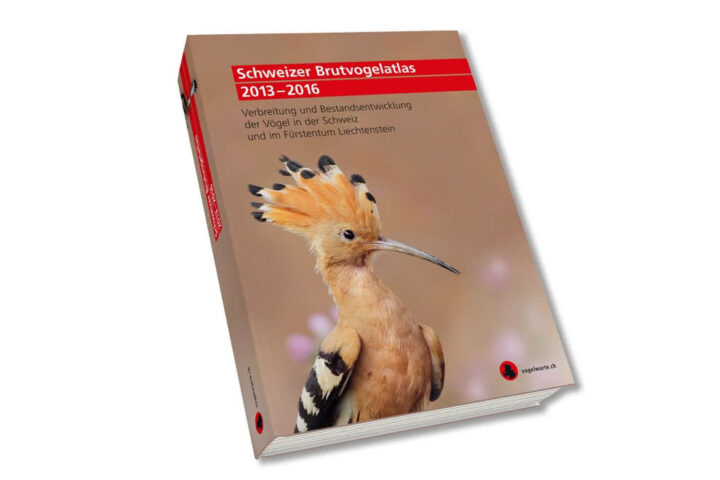
Swiss Breeding Bird Atlas 2013-2016

Unexpected breeders

The distribution of breeding birds is in constant flux. Occasionally, birds that normally breed far from Switzerland will temporarily or permanently settle in central Europe – a dynamic that never fails to surprise and fascinate birdwatchers and scientists alike.

Located at the heart of Europe and at the intersection of several biogeographical regions, Switzerland has a remarkably high species richness. This is especially true for ducks, some of which spend the summer here after wintering in Switzerland, or even breed here. Often, these species reach the periphery of their breeding range in Switzerland – Common Teal, Garganey, Northern Shoveler and Ferruginous Duck, for example. Such events are more spectacular when they involve typical maritime species. The Common Eider, a characteristic bird of northern European coasts, significantly increased its wintering population in Switzerland in the 1970s and 1980s. After several influxes, small groups began to spend the summer here. Breeding was confirmed for the first time in 1988 and occurred almost every year from 1992 onwards, albeit in small numbers, a situation that is unique in central Europe.

Red-breasted Merganser and Arctic Tern are also native to the north. Nevertheless, they have bred irregularly in the Fanel nature reserve BE/NE since 1993 and 2014, respectively. For both species, it is their southernmost breeding site. A mixed pair of Arctic and Common Tern bred in the Rhine delta A in 2010–2013. The Common Shelduck first bred in Switzerland in 1998 and has regularly bred on Lake Geneva since 2011, far away from the nearest larger populations.

Besides species that established themselves for longer periods, isolated cases of breeding occurred by birds whose colonisation process is known to be quite dynamic. Among them are Greater Short-toed Lark, Citrine Wagtail, Black-winged Stilt and Greenish Warbler. Some have only bred in Switzerland once, but others may attempt to breed again in the near future. Finally, Eurasian Dotterel and Red-spotted Bluethroat are special cases, forming small breeding populations in the central and eastern Alps, far from the northern European tundra.

It is hardly possible to find a common denominator to explain the presence in Switzerland of species with such different population dynamics. But these cases illustrate that individual pioneers, possibly responding to environmental changes, play an important role in the colonisation of a region. Such events have certainly always occurred, but they are now easier to detect and investigate thanks to the increased popularity of field ornithology, improved tools to identify birds, and the much faster dissemination of reports. Birdwatchers can look forward to more thrilling surprises in the years to come.

Species concerned

Bluethroat
Common Shelduck
Common Eider
Greenish Warbler
Garganey
Eurasian Teal
Greater Short-toed Lark
Arctic Tern
Northern Shoveler
Red-breasted Merganser
Ferruginous Duck
Eurasian Dotterel
Black-winged Stilt
Citrine Wagtail

Recommended citation of the Atlas online:
Knaus, P., S. Antoniazza, S. Wechsler, J. Guélat, M. Kéry, N. Strebel & T. Sattler (2018): Swiss Breeding Bird Atlas 2013–2016. Distribution and population trends of birds in Switzerland and Liechtenstein. Swiss Ornithological Institute, Sempach.

References

Shop

Donate
Help the birds of Switzerland.
Your support allows us to monitor stocks, identify problems, develop solutions and provide assistance to endangered species.
Donate Now
Logo Zewo

We handle the donations entrusted to us very carefully. For many years, the Swiss Ornithological Institute has carried the ZEWO seal of approval for non-profit institutions.

Swiss Breeding Bird Atlas 2013-2016

Birds face a changing world

The state of birdlife reflects our relationship with nature and our landscapes. The atlas presents the current distribution, abundance and altitudinal distribution of all breeding birds in Switzerland and Liechtenstein with unprecedented precision. Most importantly, it highlights the profound changes that have taken place in the Swiss avifauna over the past 20 to 60 years. This comprehensive reference book provides an important foundation for the protection and conservation of native birds and their habitats.

Learn more