


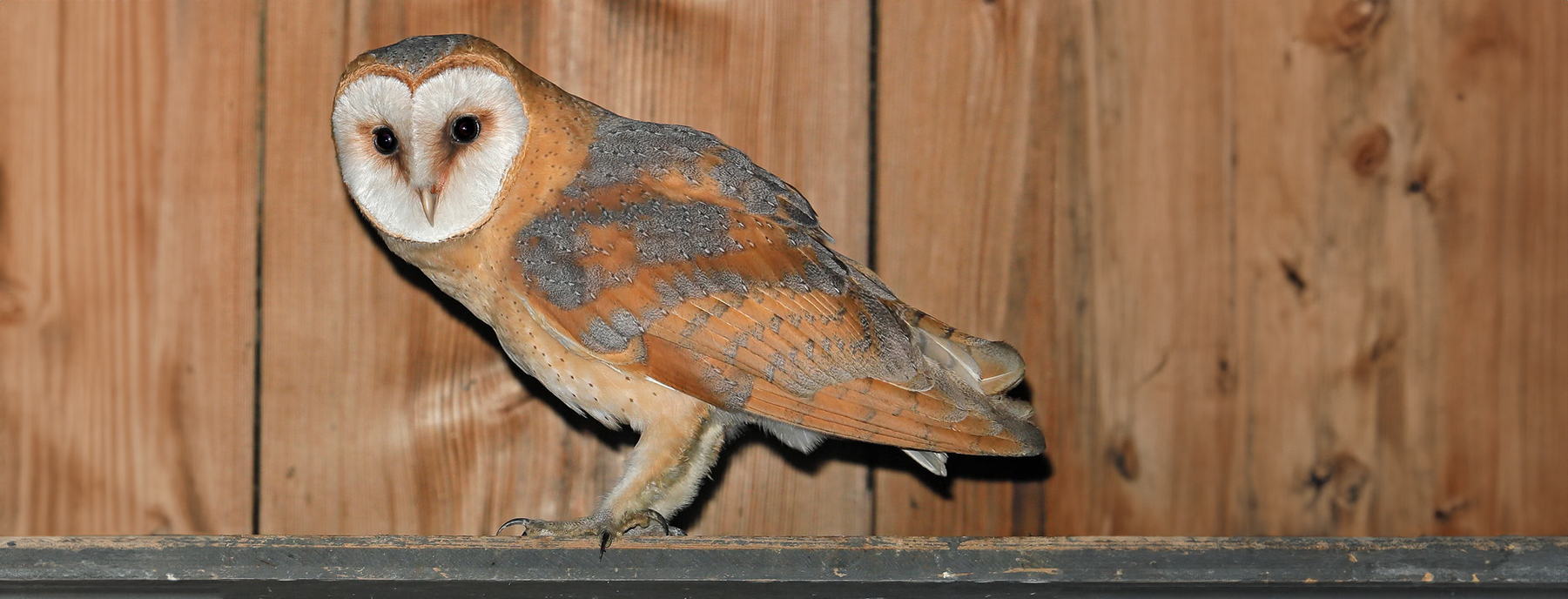
Artificial light at night (ALAN) has now become a major concern in conservation biology. For aging and breeding in agricultural landscapes, the barn owl (Tyto alba) comes in close contact with human infrastructures and is therefore exposed to ALAN. However, there are few studies investigating behavioural changes at the local level in nocturnal birds, e.g. choice of foraging areas or hunting strategies in lit and unlit areas, and the consequences for reproduction and survival. In this project we are investigating the effects of ALAN on hunting behaviour, reproductive success and offspring development.

©
© Schweizerische Vogelwarte

©
©
Anne-Caroline Heintz

©
©
Lukas Linder
Barn owl returning with prey to the nest box
A controlled experiment using street lights to study the response of barn owl prey to artificial light.
Juvenile barn owls


Effects of ALAN in the barn owl
Impacts of artificial light at night (ALAN) on a nocturnal bird of prey, the barn owl
Domain
Research
Unit
Anthropogenic influences
Topics
Birds and Human Beings, Ecology, Evolution, Species Recovery
Habitat
farmland, meadows and pastures, settlements
Project start
2023
Project status
ongoing
Project management
Bettina Almasi
Project region
Bern, Fribourg, Vaud
Details
Project objectives
The aim of this project is to unravel the consequences of ALAN on the biology of the barn owl, which is listed as near threatened in Switzerland and as a priority species for recovery programs in many countries. More specifically, we aim to investigate the effects of ALAN on the life history traits (reproduction, survival), behaviour (habitat selection and foraging strategies) and stress physiology of barn owls, as well as on the habitat selection and activity of their rodent prey.
Methodology
We use longterm data on the life history, foraging behaviour and stress hormone responses of a population of barn owls in Western Switzerland to investigate how these traits correlate with ALAN. The use of nocturnal ALAN satellite images available monthly to annually for each owl territory since 2012, allows us to investigate how changes in ALAN over the last decade affect the life history of barn owls. We are also using a variety of experimental approaches to gain more information on the consequences of ALAN on owls’ rodent prey, and on barn owl reproduction and foraging behaviour.
Significance
The results of this study will directly contribute to the knowledge of the effects of artificial light on nocturnal animals, both for basic research and for conservation measures. Indeed, it will contribute to the understanding and protection of nocturnal bird populations, and in particular to the protection of a species for which Switzerland has a particular responsibility. In addition, the study of prey species is necessary not only to better understand the responses of rodents to light pollution, but also to fully understand the subtle changes in prey predator interactions caused by light pollution.
Results
Using longterm data on the breeding traits collected on the barn owl population in Western Switzerland from 2012 to 2021 and nighttime light satellite images (from the Visible Infrared Imaging Radiometer Suite Day/Night Band), we have already shown that nesting sites most exposed to nighttime light pollution are less likely to be occupied by barn owl pairs.
Project partner(s)
- Alexandre Roulin, University of Lausanne
- Eva Knop, Agroscope
- Vincent Grognuz, Agroscope
Financial support
- Stiftung Yvonne Jacob
- Basler Stiftung für biologische Forschung
Employees

Anthropogenic influences employee
Anne-Caroline Heintz
+41 41 462 97 00
anne-caroline.heintz@vogelwarte.ch

Species concerned

Unit
Anthropogenic influences
We want to understand how human influences affect the well-being, behaviour and individual fitness of birds.


