


©
© Markus Varesvuo
Conservation programme for birds in Switzerland - Priority species
Common Redstart
The Common Redstart inhabits open woodland, tree-rich agricultural landscapes and urban areas with stands of mature trees. It hunts insects from elevated perches, catching them on the ground in patchy vegetation. From the second half of the 20th century, populations in Switzerland, particularly in the Central Plateau, began to decline, mainly due to the disappearance of traditional orchards. The population has been fairly stable since the late 1990s. Today, the main areas of distribution are on the southern side of the Alps and in Valais. The few populations spread across the Central Plateau and Jura have managed to sustain their numbers. Ensuring high tree stocks, creating structurally diverse areas including patches of open ground and installing nesting aids are crucial for their protection.
Distribution and development
Schematic distribution
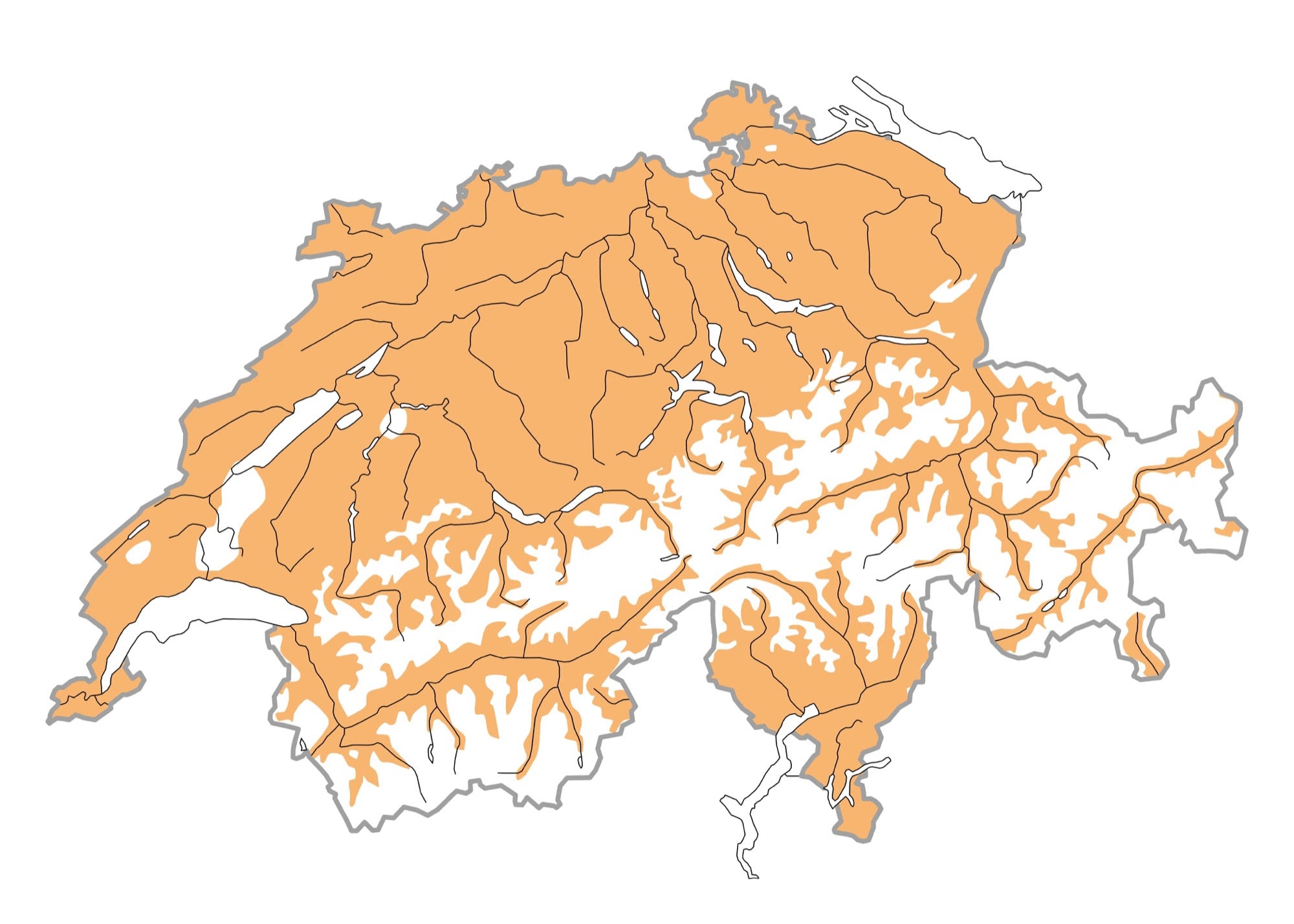
Schematic distribution during the breeding season (ochre), in winter time (dotted in blue) or during migration periods (dotted in vinaceous).
Breeding bird index
The graph shows the relative evolution of the breeding population in Switzerland (100 = mean value). Example: A value of 130 means that the population in the corresponding year was 30% above the mean value of the entire period considered.
Habitat and food

©
© Jacques Laesser
Common Redstart habitat in an urban area with lots of trees in the Vallée de Joux.

©
© Dominik Hagist
Traditional orchard with Common Redstart broods in Oberthurgau.


Conservation programme for birds in Switzerland - Priority species
Common Redstart
The Common Redstart inhabits open woodland, tree-rich agricultural landscapes and urban areas with stands of mature trees. It hunts insects from elevated perches, catching them on the ground in patchy vegetation. From the second half of the 20th century, populations in Switzerland, particularly in the Central Plateau, began to decline, mainly due to the disappearance of traditional orchards. The population has been fairly stable since the late 1990s. Today, the main areas of distribution are on the southern side of the Alps and in Valais. The few populations spread across the Central Plateau and Jura have managed to sustain their numbers. Ensuring high tree stocks, creating structurally diverse areas including patches of open ground and installing nesting aids are crucial for their protection.
Birds of Switzerland

Common Redstart
To the species profile in the bird database
Project managers


Threats, activities and forecasts
Limiting factors and threats
One of the main reasons the Common Redstart is threatened is the loss of suitable breeding habitats. In particular, valuable traditional orchards and tree stands are still being lost due to the intensification of agriculture and high-density construction in urban areas.
Breeding season
- There is a shortage of tree-rich agricultural landscapes and urban areas with large old trees (cemeteries, gardens or parks), patchy vegetation on the ground and an adequate supply of insects.
- Suitable nesting sites, such as tree hollows, crevices in buildings or nest boxes, need to be available.
Migration/ Winter
- A drought in the Sahel in the 1960s led to significant population losses.
Necessary activities
Monitoring
- Population trend is recorded through the monitoring of common breeding birds (MHB).
- Monitoring and review of success in project areas in the cantons of Thurgau/St. Gallen, north-western Switzerland, La Chaux-de-Fonds and various urban areas in western Switzerland.
Conservation
- Protection of remaining orchards / increase in area covered by standard trees, preservation of old trees (including deadwood), especially walnut and pear trees.
- Promotion of extensive underutilization and creation of patchy vegetation, e.g. through ruderal areas.
- Installation of suitable nest boxes.
- Conservation and preservation of trees and semi-natural green spaces in urban areas.
Research
- Identification of potential habitats, especially near existing populations.
- Evaluation of conservation measures, e.g. optimal quantity and spatial distribution of open ground.
Prospects for success and prognostics
- Demonstration projects in traditional orchards show the success of conservation measures but are often very time-consuming, and sufficient financial incentives are needed.
- Known populations in urban areas (including public gardens, parks, cemeteries) are stable or even increasing thanks to such measures.
- High-density construction threatens habitats in urban areas: old trees and open spaces are preserved via zone-use plans.
Conservation measures and stakeholders

Staggered mowing
Staggered mowing leads to a mosaic of low and tall vegetation and optimises food accessibility and supply.
Show more
Agriculture
Cantons

Preserve cavity trees
Hollow trees provide nesting opportunities for the Common Redstart and other cavity-nesting species.
Agriculture
Forestry
Municipalities
Nature conservation
Private individuals

Preserve/promote traditional orchards
High-stem orchards on extensive meadows, pastures and other types of ground-cover are an important habitat for many bird species.
Show more
Agriculture
Cantons
Communities
Municipalities

Create patchy vegetation
Patchy vegetation improves food accessibility at ground level.
Show more
Agriculture
Private individuals

Offer and maintain nesting aids
Installing and maintaining nest boxes or artificial nests helps counteract the lack of natural nesting sites.
Show more
Agriculture
Nature conservation
Private individuals

Promote singing or hunting perches
Individual shrubs, trees or wooden posts can serve as singing and hunting perches and improve habitat quality.
Show more
Agriculture
Nature conservation
Private individuals


Publications

©
© Markus Varesvuo
Birds of Switzerland
Common Redstart
The Common Redstart is one of our most splendid songbirds and generally easy to observe. Since the 1960s it has suffered a great loss of territory, especially in the Swiss lowlands north of the Alps. In remaining fruit-growing regions often only individual males can be encountered with their melancholy song. The Common Redstart is a long-distance migrant and passes half the year in t...
To the species profile in the bird database


