©
Grey Partridge © Beat Rüegger
Swiss Breeding Bird Atlas 2013-2016

Continued decline of Red List species

Threatened species on the Red List are most frequently found in the Jura, the inner-Alpine valleys and the wetlands of the Central Plateau. Only very few threatened species still breed in areas of intensively cultivated farmland. Since 1993–1996, the species on the Red List have become rarer in most parts of Switzerland, highlighting the urgent need for additional, species-specific protection.

Red Lists assess a species’ risk of extinction in a given region based on criteria defined by the International Union for Conservation of Nature (IUCN). They have proven an important tool in nature conservation and are published for Switzerland by the Federal Office for the Environment (FOEN). The Red List of threatened breeding birds in Switzerland includes 78 species following its last revision in 2010. 41 species are classified as «Vulnerable» (VU) and 21 as «Endangered» (EN), while nine species are considered «Critically Endangered» (CR). The Red List also includes seven former breeders – species that have not bred in Switzerland for more than 20 years (category «Regionally Extinct», RE). Birds in the categories «Near Threatened» (NT, 32 species) and «Least Concern» (LC, 89 species) are not considered Red List species.

In the 2010 revision, 12 species were removed from the 2001 Red List. Of these, Red-crested Pochard, Peregrine Falcon, Middle Spotted Woodpecker, Cirl Bunting and others show significant gains compared to 1993–1996. Some species that have remained on the Red List also exhibit positive trends, including White Stork, Bearded Vulture, Eurasian Scops-owl, Little Owl and Common Hoopoe. Across large areas, however, the negative trends dominate. Not surprisingly, therefore, ten new species had to be added to the Red List in 2010. Woodchat Shrike and Eurasian Curlew, once widespread, disappeared completely as breeding species before the 2013–2016 survey period. In the case of Grey Partridge, Common Snipe and Ortolan Bunting, only individual territories remain, and these species are expected to disappear from Switzerland in the foreseeable future.

On the Central Plateau, only wetlands still support several threatened species

Steep declines at low and medium altitudes

Many threatened species in wetlands and in farmland

Urgent effort needed to protect threatened species

Species concerned

Bearded Vulture
Common Snipe
Whinchat
Common Whitethroat
Willow Warbler
Corn Bunting
Eurasian Curlew
Hazel Grouse
Northern Lapwing
Red-crested Pochard
Middle Spotted Woodpecker
Ortolan Bunting
Grey Partridge
Ring Ouzel
Woodchat Shrike
Little Owl
Fieldfare
Wood Warbler
Peregrine Falcon
White Stork
Eurasian Hoopoe
Cirl Bunting
Eurasian Scops Owl

Recommended citation of the Atlas online:
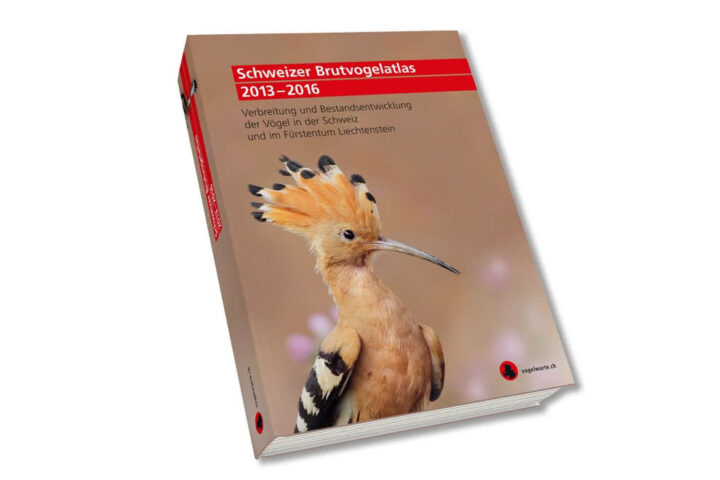
Knaus, P., S. Antoniazza, S. Wechsler, J. Guélat, M. Kéry, N. Strebel & T. Sattler (2018): Swiss Breeding Bird Atlas 2013–2016. Distribution and population trends of birds in Switzerland and Liechtenstein. Swiss Ornithological Institute, Sempach.

References

Shop

Donate
Help the birds of Switzerland.
Your support allows us to monitor stocks, identify problems, develop solutions and provide assistance to endangered species.
Donate Now
Logo Zewo

We handle the donations entrusted to us very carefully. For many years, the Swiss Ornithological Institute has carried the ZEWO seal of approval for non-profit institutions.

Swiss Breeding Bird Atlas 2013-2016

Birds face a changing world

The state of birdlife reflects our relationship with nature and our landscapes. The atlas presents the current distribution, abundance and altitudinal distribution of all breeding birds in Switzerland and Liechtenstein with unprecedented precision. Most importantly, it highlights the profound changes that have taken place in the Swiss avifauna over the past 20 to 60 years. This comprehensive reference book provides an important foundation for the protection and conservation of native birds and their habitats.

Learn more