©

Aerial view of the border region near Wallbach AG/D. The German area on the right bank of the Rhine has more small habitat structures than Switzerland on the left. These differences are particu-larly pronounced in agricultural areas.

© Swisstopo
Swiss Breeding Bird Atlas 2013-2016

Richer breeding bird community beyond our border

In neighbouring countries across the Swiss border, there are more bird species, higher densities and more Red List species per kilometre square than on the Swiss side of the border. These differences are explained by the greater number of semi-natural spaces and small habitat structures in these neighbouring regions, which in turn is a consequence of different cultivation methods and land use as well as the different arrangement of landscape elements.

In addition to the kilometre squares in Switzerland, 145 kilometre squares that lie at least partly in neighbouring countries along the Swiss border were surveyed for the 2013–2016 atlas. The analysis presented here looked at a belt of 10 km on both sides of the border. Along the French border in the west, 59 kilometre squares in France and 160 in western Switzerland were included; along the German border in the north, 38 kilometre squares on German territory and 99 in northern Switzerland were covered. The border regions with Austria and Liechtenstein in the east and Italy and France in the south were not included in the analysis, as they vary considerably in terms of habitat types and altitude.

In the border regions with Germany and France, the percentage area covered by each habitat type is comparable on both sides. At 2 %, the average proportion of built-up areas is slightly higher in Switzerland than across the border, where it is 1.5 %; the proportions of woodland (31 and 35 %, respectively) and farmland (48 and 50 %, respectively) are slightly lower. The average elevation is the same on both sides of the borders with Germany and France, so climatic differences are likely to be modest.

Higher densities and greater species richness on the other side of the border

Marked differences in the case of farmland birds

No change since 1993–1996

Species concerned

Recommended citation of the Atlas online:
Knaus, P., S. Antoniazza, S. Wechsler, J. Guélat, M. Kéry, N. Strebel & T. Sattler (2018): Swiss Breeding Bird Atlas 2013–2016. Distribution and population trends of birds in Switzerland and Liechtenstein. Swiss Ornithological Institute, Sempach.

References

Shop

Donate
Help the birds of Switzerland.
Your support allows us to monitor stocks, identify problems, develop solutions and provide assistance to endangered species.
Donate Now
Logo Zewo

We handle the donations entrusted to us very carefully. For many years, the Swiss Ornithological Institute has carried the ZEWO seal of approval for non-profit institutions.

Swiss Breeding Bird Atlas 2013-2016

Birds face a changing world

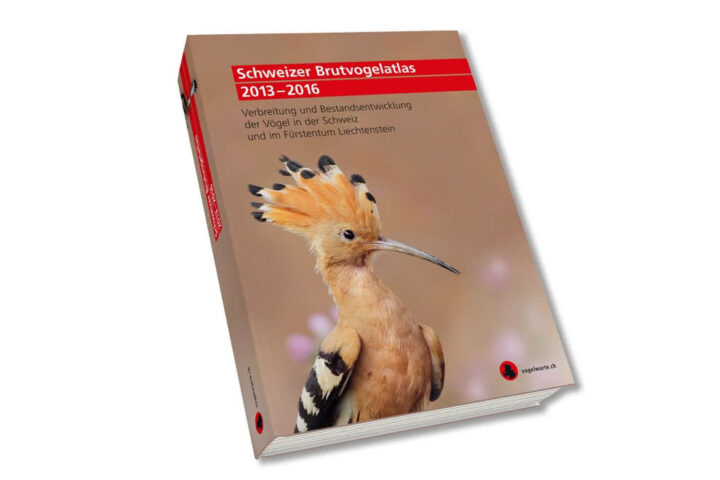
The state of birdlife reflects our relationship with nature and our landscapes. The atlas presents the current distribution, abundance and altitudinal distribution of all breeding birds in Switzerland and Liechtenstein with unprecedented precision. Most importantly, it highlights the profound changes that have taken place in the Swiss avifauna over the past 20 to 60 years. This comprehensive reference book provides an important foundation for the protection and conservation of native birds and their habitats.

Learn more