

The northern nutcracker and Swiss stone pine (or Arolla pine; Pinus cembra) share a remarkable mutualism: the nutcracker feeds on pine seeds, while the pine relies on the nutcracker for dispersal. Yet, not all nutcrackers cache seeds in suitable sites. Our project explores how individual differences and developmental changes in seed caching behaviour influence this partnership. Using GPS tracking and ecological modelling, we reveal how these behaviours shape nutcracker survival and reproduction — and determine plant recruitment and thus the future of Swiss stone pine forests under climate change.

©
© Matthias Tschumi
Nutcracker on top of a Swiss stone pine tree with cones ready to be harvested.

©
©
Matthias Tschumi
The northern nutcracker is the main disperser of Swiss stone pine seeds.

©
©
Valentin Graf
Nutcracker equipped with a GPS transmitter which will reveal where it is caching Swiss stone pine seeds.

©
©
Matthias Tschumi
Nutcracker harvesting Swiss stone pine seeds for caching as a winter storage.

©
©
Matthias Tschumi
Swiss stone pine cones where a nutcracker has started extracting seeds.

©
©
Matthias Tschumi
Stone pine seeds cached and forgotten in the soil by nutcrackers can emerge into new seedlings.

©
©
Matthias Tschumi
By planting trees at the upper treeline, nutcrackers enable the Swiss stone pine to colonise higher elevations.

©
©
Matthias Tschumi
Such Swiss stone pine landscapes can only persist with the help of nutcrackers.

©
©
Matthias Tschumi
Some nutcrackers cover large distances for caching their seeds.

©
©
Matthias Tschumi
By downloading and analysing GPS data of tagged nutcrackers, researcher can analyse their seed dispersal movements.

©
©
Valentin Graf
Seed dispersal movements of a GPS-tagged nutcracker near Davos.


©
© Matthias Tschumi

©
©
Matthias Tschumi

©
©
Valentin Graf

©
©
Matthias Tschumi

©
©
Matthias Tschumi

©
©
Matthias Tschumi

©
©
Matthias Tschumi

©
©
Matthias Tschumi

©
©
Matthias Tschumi

©
©
Matthias Tschumi

©
©
Valentin Graf
Nutcracker on top of a Swiss stone pine tree with cones ready to be harvested.
The northern nutcracker is the main disperser of Swiss stone pine seeds.
Nutcracker equipped with a GPS transmitter which will reveal where it is caching Swiss stone pine seeds.
Nutcracker harvesting Swiss stone pine seeds for caching as a winter storage.
Swiss stone pine cones where a nutcracker has started extracting seeds.
Stone pine seeds cached and forgotten in the soil by nutcrackers can emerge into new seedlings.
By planting trees at the upper treeline, nutcrackers enable the Swiss stone pine to colonise higher elevations.
Such Swiss stone pine landscapes can only persist with the help of nutcrackers.
Some nutcrackers cover large distances for caching their seeds.
By downloading and analysing GPS data of tagged nutcrackers, researcher can analyse their seed dispersal movements.
Seed dispersal movements of a GPS-tagged nutcracker near Davos.
Dispersal of Swiss stone pine seeds by northern nutcrackers
How individual behaviour shapes ecosystem functions
Domain
Research
Unit
Ecological research
Topics
Birds and Human Beings, Distribution Ecology, Ecology
Habitat
alpine habitats, forest
Project start
2024
Project status
ongoing
Project management
Matthias Tschumi
Project region
Grisons
Details
Project objectives
We investigate how individual differences and developmental changes in nutcracker behaviour influence both bird fitness and Swiss stone pine dispersal. Specifically, we aim to (1) assess behavioural variation in seed caching and its development over time, (2) quantify its effects on nutcracker survival, reproduction, and dispersal and (3) model how these behaviours shape Swiss stone pine recruitment and upslope range shifts under climate change.
Methodology
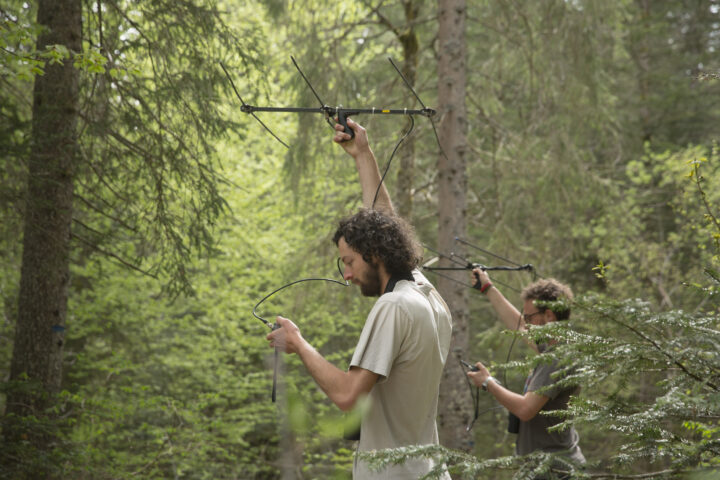
We capture juvenile and adult nutcrackers in the Swiss Alps and equip them with solar-powered GPS tags to record their year-round movements. GPS and accelerometer data help identify seed caching, survival and breeding behavior. Using movement analysis and ecological models, we link behavioral types and their development to survival, reproduction, and dispersal of nutcrackers. Finally, we integrate these data with pine seedling establishment models to predict their effects on forest dynamics under climate change.
Significance
This project addresses a critical gap in understanding how individual behavioural variation and its ontogenetic development shape ecosystem functions. By studying the nutcracker–Swiss stone pine mutualism, we aim to uncover how, and under which conditions, specific behaviours benefit or impede fitness components of both partners. These insights will advance our ecological understanding, improve predictions of ecosystem responses to global change, and inform conservation of emblematic Alpine habitats.
Results
Our findings reveal age- and individual-based differences in nutcracker behaviour associated with seed dispersal. Adults followed two distinct seed dispersal strategies: short-distance caching at high elevations vs. long-distance caching at lower elevation sites. Juveniles dispersed seeds over larger ranges and cached at higher elevations than adults and were less efficient and less skilled in cone handling. These individual and ontogenetic differences thus affect the quantity, quality and spatial pattern of dispersed seeds with potential downstream effects on pine recruitment.
Project partner(s)
- PD Dr. Eike Lena Neuschulz, Senckenberg Biodiversity and Climate Research Centre, Frankfurt
- Prof. Dr. Thomas Müller, Senckenberg Biodiversity and Climate Research Centre, Frankfurt
- Dr. Kurt Bollmann, Swiss Federal Institute for Forest, Snow and Landscape research WSL, Birmensdorf
- PD Dr. Michael Schaub, Swiss Ornithological Institute, Sempach
- Dr. Valentin Graf, Senckenberg Biodiversity and Climate Research Centre, Frankfurt
Financial support
- Yvonne Jacob Foundation
Employees



Species concerned


Unit
Ecological research
We investigate the diverse interactions of birds with their environment, from individual settlement behaviour to species communities.