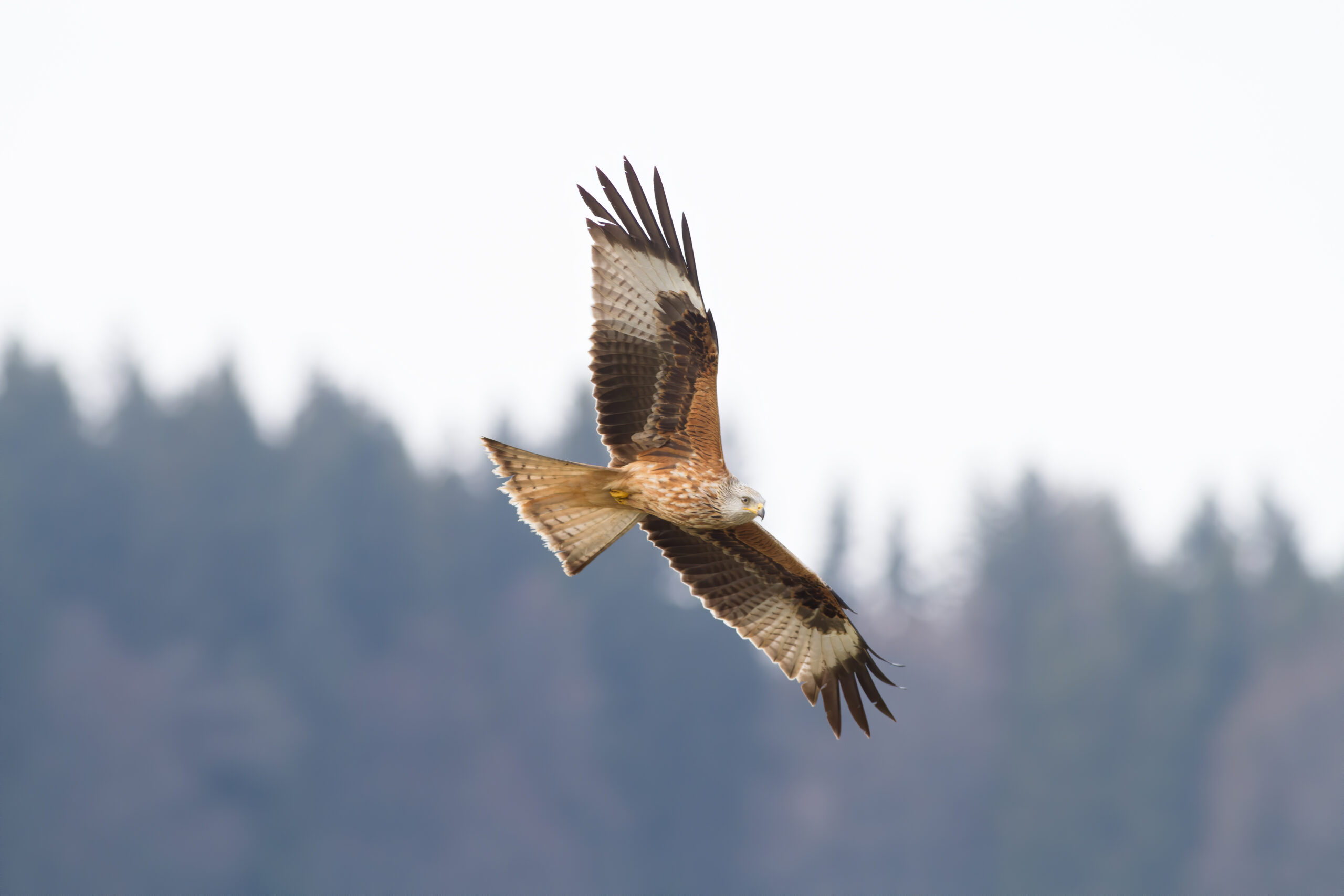

The effect of food supplementation on range use of breeding red kites (Milvus milvus) in Switzerland
Zusammenfassung
In ecology, home ranges are used to determine a bird’s extent of spatial use over a certain, mostly biologically meaningful time-period. This approach keeps effects of daily changing environmental influences in the dark. Of a few raptors it is known, that males have larger home ranges than their females during breeding season. If the same environmental factors reveal sex-specific effects remains in question. Here, I quantified sex-specific effects of different weather influences, food availabilities and nestling ages on the daily home range size. The correlation of food availability and weather was eluded by setting up a nest-selective feeding experiment of GPS-tagged red kites (Milvus milvus) during their breeding period. Data from unfed but also breeding individuals was used as control. The results revealed a pronounced sexspecific spatial behavior where females did not change their home range size due to short-term environmental changes. In contrast, males showed decreases of daily home range sizes under adverse weather conditions, on days of feeding and with increasing nestling age. The results point to an increase in foraging efficiency, when energy demand increases, or the food availability is locally raised. However, smaller home ranges under adverse conditions are suggestive of causing too high energy costs and a temporal interruption of foraging. This thesis proofs that male red kites adapt their daily home range behavior to a daily changing environment. This is likely caused by energetic reasons. Based on these results, predictions of range use of red kites in the study area during the nestling period are possible.