Restoring habitat quality for Skylarks in winter cereal fields by manipulating the crop architecture
Zusammenfassung
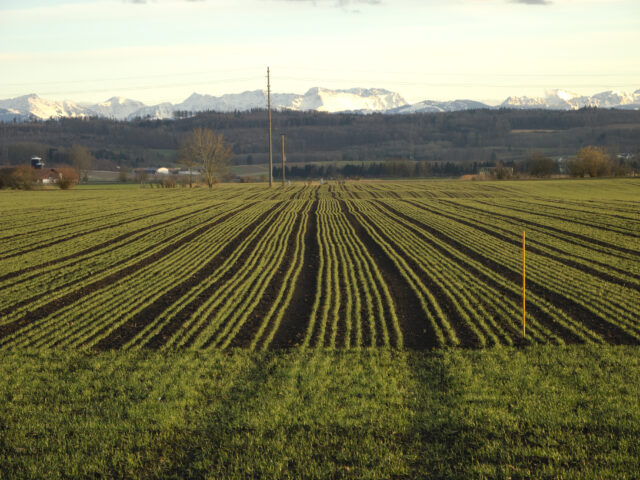
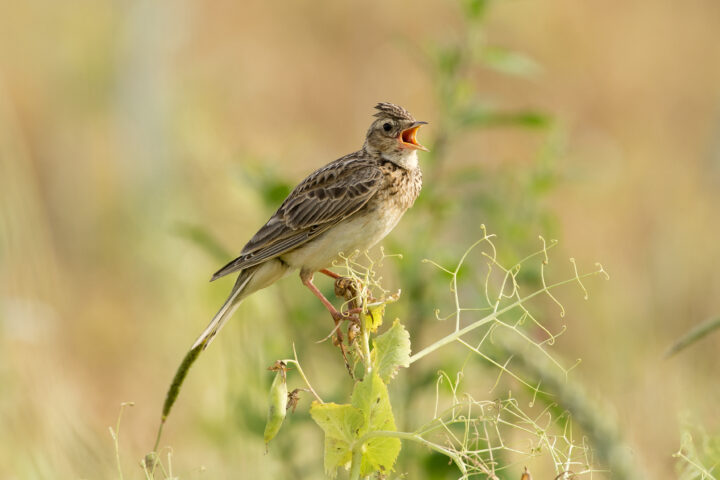
Losses of suitable foraging and nesting habitats are key drivers for ongoing declines of farmland birds. For Eurasian Skylarks (Alauda arvensis), this is reflected by the lack of sparse and short vegetation structure (i.e., crop architecture). Existing countermeasures outside cultivated areas seem unable to off2set declines, indicating the need for in-field measures, ideally in cereal fields which cover large shares of agricultural land and ideally without compromis3ing yields. We experimentally tested whether unsown Skylark strips in intensive winter cereal fields (treatment) provided sparse and short crop architecture through4out the breeding season and whether this improved habitat quality by compar5ing key parameters of Skylark populations on treatment fields and fields without Skylark strips (control). Further, we tested whether the size and direc6tion of effects of the measure depended on surrounding landscape features and seasonality.
Breeding performance was improved in treatment fields: the odds for nests being successful were 12.5 times that of control fields. During important phases of the breeding season, prey density and parental foraging were increased in treatment fields. Territorial behavior was higher in treatment fields throughout the breeding season, which was also less dependent on other attractants (i.e., proximity to ecotones) compared to control fields. Habitat use was increasingly higher in treatment fields as the breeding season progressed. Further, the availability of small-parceled fields in the surrounding area was related to decreased habitat use in control fields but not in treatment fields. In general, habitat use in cereal fields depended on adjacent habitat types, with the presence of spring sown crops leading to the largest declines. We conclude that Skylark strips can improve habitat quality for Skylark nest7ing and foraging in intensive winter cereal fields. Given the previously shown yield stability, this encourages large-scale implementation of this measure for Skylark conservation, which might be most beneficial on large winter cereal fields in landscapes where there are few spring-sown crops
Mitarbeitende